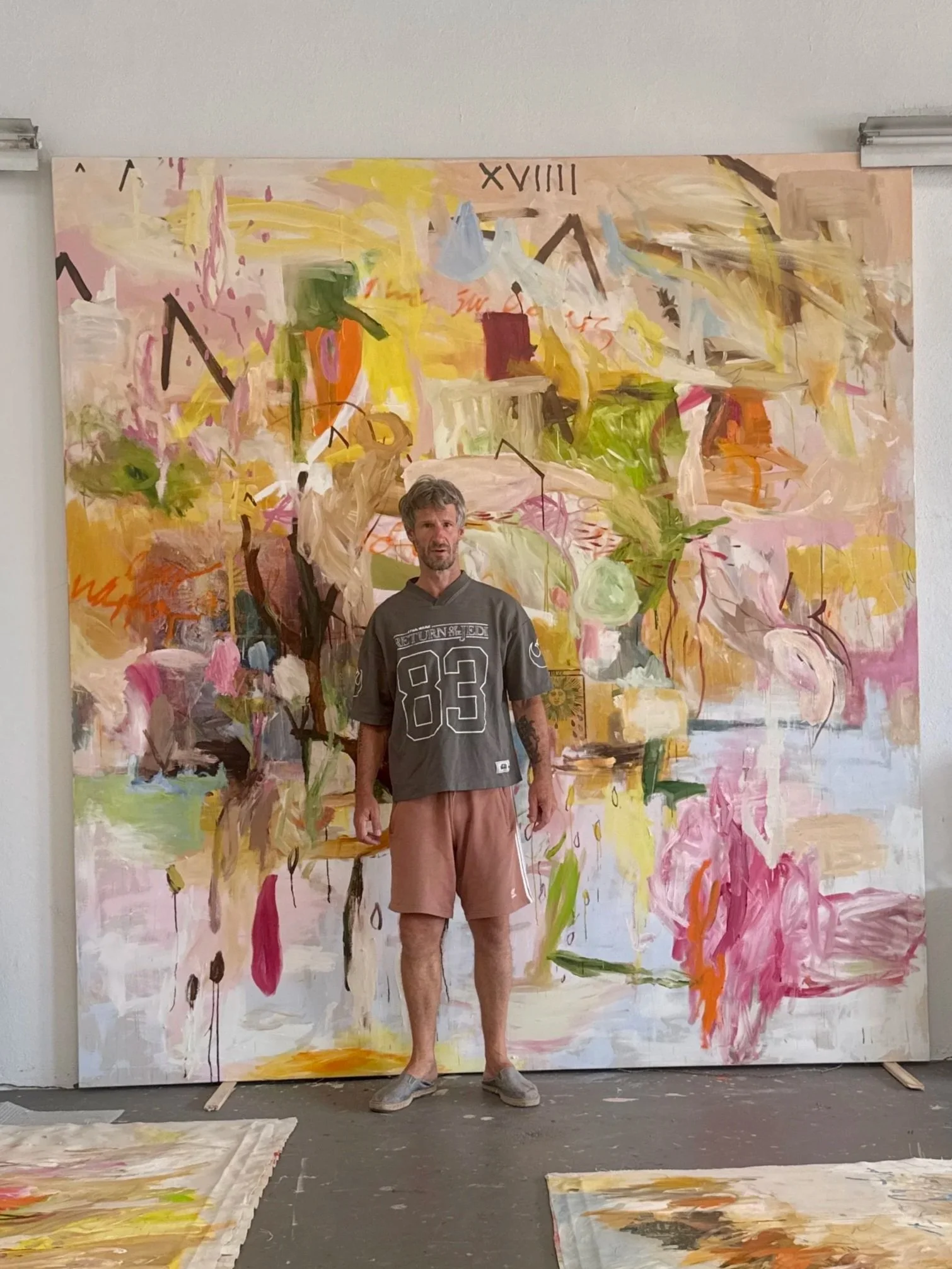
Entrevista a Stefan Heyer
You often describe your paintings as a space between personal history, pop culture, politics, and postmodern alienation. How do these different layers find their balance inside a single work?
My paintings are obviously a mirror of all my interests, thoughts, doubts, influences, inspirations. A trigger for a painting can be a text I’m reading at the moment — often philosophical or esoteric stuff — or a color chord I unconsciously picked up somewhere in daily life, or simply an accumulated energy coming from music, nature, or an image I find online which then becomes a starting point through photo transfer.
I always go with the flow. Things come to me — images, texts — I don’t really search for them. Depending on my mood, one aspect becomes stronger than another. Sometimes it’s also just a painterly challenge where I impose restrictions on myself: make an extremely dense painting but only use colors you normally avoid, like blue or whatever.
I’m interested in the deeper aspects of existence, universal questions, myths, archetypes.
Your work seems to oscillate between control and chaos — between intentional composition and surrendering to the process. At what point does a painting begin to “tell you” what it needs?
That’s a good question. Like I said before, one or several found images can already define the basic vibe of a painting, especially in terms of color. Right now for example in my “Sophia Dreaming About the Earth” series I use medieval illustrations of alchemical processes.
I place these images on the canvas in a loose layout and then start painting around them. This can happen in a very careful, almost microscopic way, or through expressive writing of keywords, or completely free painting in order to enter some trance-like state and give up control.
After such a session comes the conscious intervention — covering areas I don’t like. At a certain point the painting itself decides the next step. And I allow that.
I always work in many short sessions because high energy is essential for me. I can’t just push paint around like it’s a 9-to-5 office job. I work fast and impulsive. Sometimes I stare at a painting for ten minutes, but honestly that’s rare. Usually I work directly in front of the canvas. I almost never step back and “analyze.”
Sometimes I enter the studio, see the painting from far away and immediately know it doesn’t work anymore. Then a big gesture has to happen.
That’s how the layers build up and a density appears that has force, something unavoidable. So it’s always chaos, intervention, control, freedom. No fear of the next uncertain step — same as life.
If it becomes paint-by-numbers and always the same thing, it gets boring and cowardly. Same as in real life.
There is a strong physicality in your surfaces: drips, fragments, erased gestures, photographic traces, words. Do you think of painting as a form of excavation or accumulation?
Like I said before, I don’t spend two hours planning whether I should paint a yellow area and then execute it cleanly without depth. I just begin — with immediate impulses and decisions, with a sentence, a melody in my head, a vibe, a word, a poem.
Every new session reacts to what is already there: covering, reinforcing, picking up, weakening, erasing. Slowly, through many sessions, the painting builds itself.
Because I work with oil paint I always have enough time to interfere, to mix colors — always directly on the canvas, never on a palette — to interrupt things with white, moving from thin layers to thick ones.
So yes, it’s forgetting and remembering, excavating and burying at the same time.
I have to surprise myself. I don’t have problems with contradictions, open ends, loose ends. I’m not a control freak. I accept the process and intervene until the balance — or maybe also imbalance — finally feels right to me.
Having grown up in West Germany and later living between places like Hamburg, Barcelona, and rural landscapes, how has geography shaped your emotional relationship with painting?
I’m a wanderer between worlds.
My colors come from nature. That’s an automatism inside me after fifty years of looking and absorbing.
My very first road trip outside Germany happened in the late 80s when I was twenty. Two friends, an old car, driving through Spain all the way down to Tarifa, the southernmost point of Europe. Since then I’ve been obsessed with Mediterranean light. I always paint in natural daylight, never at night with artificial light. And of course I love the colors here — and the people and food too ;)
Years later I spent a lot of time in California as a skateboarder in the early 90s. That landscape deeply impressed me too — the emptiness, the width, the silence. The colors reminded me again of Spain. The Costa Brava became my European California somehow.
At the same time I cannot exist without the German forests, the deep green, the plants, the smells. Both worlds shaped me forever, also during the years when I lived and painted in Hamburg St. Pauli next to the sinful Reeperbahn.
Human contact itself doesn’t directly influence a painting emotionally. Those energies come from somewhere else. I draw energy from culture, music, books. I return to old inner lakes.
Many of your works contain an underlying tension between beauty and collapse. Are you searching for harmony, or are you more interested in revealing contradiction?
Beauty and collapse — I like that.
I mean, this is exactly the state we live in: this beautiful, fragile and also evil world.
We artists are sun warriors and Jedis, we have to keep the balance. The ancient fight between good and evil is real to me. Götterdämmerung is happening. I fight for the good, but at the same time I also love dystopian 70s movies.
I don’t work dialectically. I don’t want to expose or uncover something. I’m more interested in contradiction, in brokenness.
I search for a universal beauty, but not a colorful superficial boring beauty. The destructive element always has to be inside it. If I manage this balancing act, then I’m happy and surprised myself.
The beautiful thing about art is this universal level beyond words. The whole world can become a guest inside your painting. Every person sees something different, participates differently, and still somehow it’s also the SAME.
That’s completely insane. One Love.
Your paintings often feel musical — rhythmic, layered, atmospheric. Do music, sound, or specific cultural references play an active role in your studio process?
For sure. I’m an absolute music freak.
I’ve been buying vinyl since 1979 and went through all kinds of underground and overground music. I ALWAYS listen to music, but I don’t paint to music.
I listen to a lot of Dub Techno or Ambient, very atmospheric stuff, but that doesn’t mean I paint slowly because of it. I simply need the soundtrack, the atmosphere around me all the time.
Same as natural light and sun.
You once said that a painting should remain a mystery. In an age where images are consumed instantly and constantly explained, how important is ambiguity for you today?
Very important.
Surviving this flood of images is not easy, but at least I know exactly what I personally like. It’s always the same visual triggers that attract me. I can easily shut out this endless mainstream meme/reel culture simply by ignoring things like TikTok.
I think only art can really hit you deep inside, not documentary photography about some daily political issue. Art has to strike a universal string.
If I immediately understand everything, I get bored.
What I described before is necessary for me in order to create an ambiguous tension: a dense atmosphere with details. Second and third looks matter. The viewer should always be able to discover something new.
Painting is also like music: you love a certain melody, a beat, a riff — or you don’t.
I’m drawn to everything in art, music, film, literature, people — everything that is not completely clear, that leaves enough space to ignite my own imagination.
There is something deeply human in the way your works resist certainty. Do you see painting as a way of preserving complexity against the simplification of contemporary culture?
To explain it through music: I hate guitar solos and saxophone solos, but I love the fusion of Miles Davis. It’s complex but still earthy and grounded.
Pure technical virtuosity in music or art is boring to me. Pseudo-complexity is actually under-complexity.
But I’m also not looking for fake simplicity. I leave contradictions unresolved.
And I don’t endlessly repeat the same formal formula like many contemporary artists do. They find one idea and ride it to death forever.
That doesn’t mean I do the opposite and just experiment randomly all the time, but I want to create several escape routes for myself, different strategies — playful but mysterious.
Your practice combines abstraction with fragments of the visible world. What attracts you to that threshold where recognition almost appears and then disappears again?
Exactly this threshold — this thin line between certainty and undermining certainty.
Only inside this conflict can tension exist, in my opinion.
Like the cut-off ear inside the idyllic suburban garden in Blue Velvet.
After years of developing a very distinctive visual language, what still surprises you about painting? What continues to keep the medium alive for you?
First it was important to develop this language, to really find my own language. It took me ages to overcome some of my big masters like Basquiat or Twombly.
I’m a late bloomer in other aspects of life too, so that’s fine with me.
I’m also completely autodidactic — already back in my old life as an art director and graphic designer. The DIY ethos from my teenage post-punk upbringing in the 80s was always essential.
I never read manuals and I never ask other people for advice. I have to try things myself, fail myself, do it again and again and again.
And when I get bored with myself I invent strategies: no photo transfer at all — or only photo transfer. Only use these colors. Throw away all brushes. Paint only with the right arm even though I’m left-handed. Stuff like that.
And when it works, I surprise myself and become excited again.
If I’m not in the mood, I don’t paint. I’m not in the studio every single day working. For me this is precious, not a 9-to-5 routine.
I also don’t believe in this “work work work paint paint paint” ideology where more automatically means better. Sometimes it’s the opposite.
If I have a block, I accept it. Then I go to the beach and drink a beer ;)
To finish: a favorite book, album, and film
I would need to give you a top 50 for each :) Tough one.
BOOK:
My favorite book ever is Frederick by Leo Lionni. It came out the year I was born, 1967, and it’s about a mouse called Frederick who is basically the artist inside a whole community of mice. I absolutely love that late-60s graphic style. Similar to Eric Carle and The Very Hungry Caterpillar — Raupe Nimmersatt, La oruga muy hambrienta. Love that too. I also read those books thousands of times to my kids, so there’s a lot of deep memory connected to them.
FILM:
The last ten years I watched all those beautiful HBO, Netflix whatever series — you know them — but when it comes to an all-time Top 3 it’s probably either The Shining, 2001 or A Clockwork Orange by Stanley Kubrick, or Twin Peaks: Fire Walk with Me by Lynch, which completely killed me in the early 90s. But maybe my favorite film ever is Don’t Look Nowby Nicolas Roeg (Wenn die Gondeln Trauer tragen). It’s so poetic, visually unbelievable and at the same time deeply frightening.
ALBUM:
Impossible to name just one favorite album, but I always return to Bitches Brew by Miles Davis, the 70s Black Ark productions by Lee Scratch Perry, the Let’s Get Lost soundtrack by Chet Baker, Zen Arcade by Hüsker Dü or Rhythm & Sound w/ the Artists.
Most recently I heavily rediscovered Dub Techno again — including newer stuff like Ghost Dubs but also classic 70s Dub. Right now my favorite album is probably the very overlooked 2010 record A Paean to Wilson by The Durutti Column.